
BusyIncorporated

AI advisory for private equity

The AI upside needs
an operating plan.

I work with lower-middle-market investors and their companies to test the AI thesis, choose the work worth automating, and map a practical path into operation.

Principal-led advisory. Work directly with Jeff Wells.

$5M → $200MTuft & Needle · four years
Employee #3 & Chief of Staff

Founding CTO, twice.Milo & Batch.
Payments and back-office automation.

Operator + AI builder.Founder, Wells Capital & Busy.
Former CTO & Head of AI, Ichi.

Where I can help

Three places to start.
One standard: useful work.

Bring the decision you’re facing. We’ll scope the work around it.

01Before you buy

What belongs in the investment case?

Pressure-test the AI thesis against the company’s actual workflows, systems, and exceptions. Separate an opportunity you can defend from one you still need to prove.

Scoped deliverable

AI diligence memo

  • Prioritized opportunities and the evidence behind them
  • Build costs, ongoing costs, and operating dependencies
  • Base-case assumptions separated from unproven upside
Discuss a live deal

02In your portfolio

Where can the team get time back?

Start with the reporting, reconciliation, or order entry someone does every week. Design a focused pilot around the people doing the job and the systems they already use.

Scoped deliverable

Pilot and operating plan

  • One workflow, a baseline, and a measurable success condition
  • A named owner, approval rules, and exception handling
  • A build scope and a handoff the team can operate
Discuss a portfolio company

03Inside your firm

What keeps falling between the tools?

Deal screening, data-room questions, CRM updates, and the follow-up after the call. Define what AI can carry forward so the team can spend more time on judgment and relationships.

Scoped deliverable

Firm workflow blueprint

  • The handoffs worth automating across your existing tools
  • Source-backed work products and human review points
  • A first implementation scope with clear responsibility
Discuss your firm’s workflow

How the work gets grounded

A better demo isn’t
a business case.

We follow the work from input to finished output, including the awkward exceptions. Then we test the assumptions that determine whether changing it is worthwhile.

Hours saved are a starting point. What the business can do with them is the question.

The standard behind every recommendationFour questions. Answered.
01What is the job?
The real volume, systems, handoffs, and exceptions—not just the happy path.
02Does it pay to change it?
Time recovered, costs incurred, and what must happen for capacity to become financial benefit.
03Who stays accountable?
A named owner, access limits, approval points, and a way to catch failures.
04What earns the next step?
Evidence to proceed, a pilot to resolve uncertainty, or a reason to leave the process alone.

A recommendation can be to build, investigate further, or leave it alone.

Inside the work

Keep the source.
Question the answer.

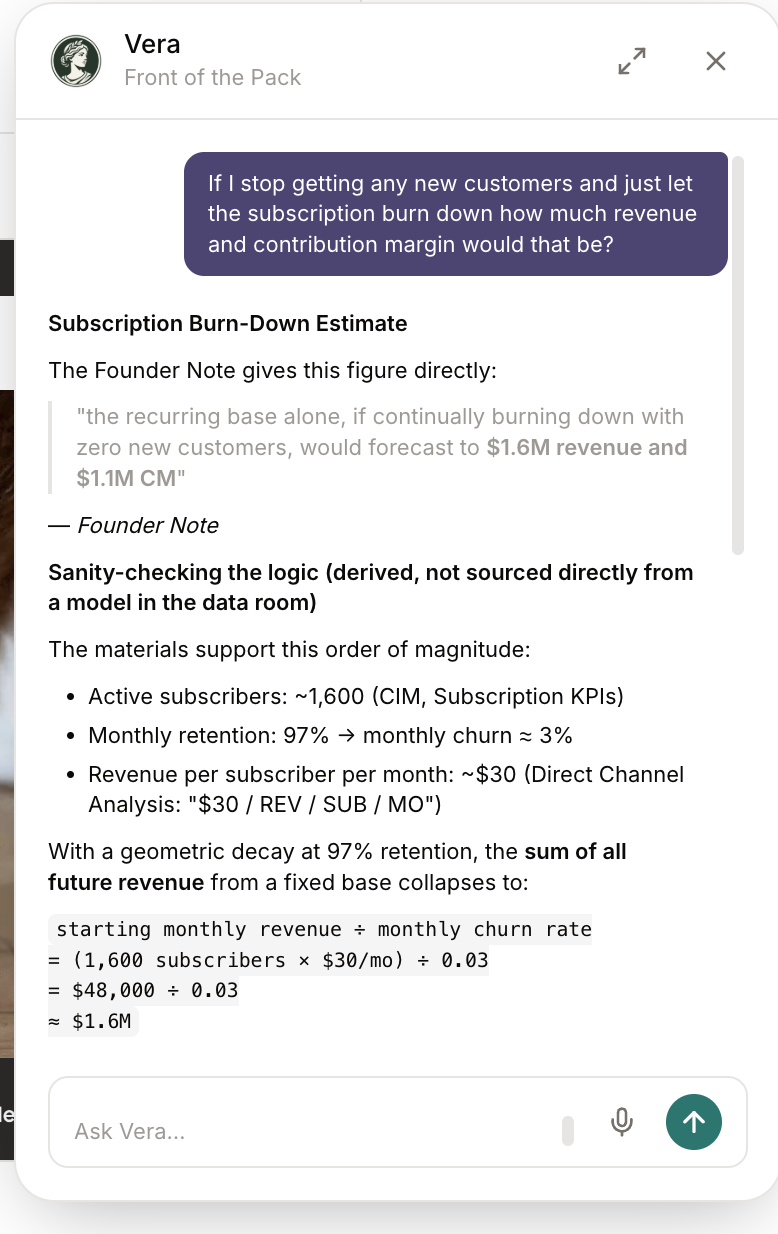
What happens to subscription revenue if new customer acquisition stops? In this deal-room example, Vera separates the founder’s statement from a calculation used to check it.

The source
The founder’s claim stays attributed to the Founder Note.
The reasoning
The derived calculation shows its inputs and retention assumption.
The judgment
The deal team still has to decide whether those assumptions hold.
Open the full example

Also building for the deal team: DealSift, thesis-driven deal search

Vera’s subscription burn-down analysis, showing a Founder Note reference followed by a separately labeled derived calculation.
Example deal-room analysis. Source statement and derived logic remain separate.

Your advisor, in the work

I have to make
the plan work, too.

I’m Jeff Wells. I’ve helped scale a consumer business, built software companies, and now run Wells Capital while building Busy.

That puts me on both sides of the question: what the technology can do, and what the business can actually absorb. A workflow still has to survive the messy spreadsheet, the missing data, and the person who has a customer to help.

I bring those questions into the engagement from the start. The work should leave your team with less to carry and a clear owner for what comes next.

More about Jeff at Wells Capital
Tuft & Needle

Employee #3 · Chief of Staff

Helped scale from $5M to $200M in four years.

Milo / Batch

Founding CTO, twice

Payments and back-office automation.

Klaviyo / Ichi

New Ventures / CTO + Head of AI

Ecommerce infrastructure and AI systems.

Wells Capital / Busy

Founder

Operating consumer brands. Building AI that does the work.

Working together

A clear scope.
A useful next step.

One consequential problem is a good place to begin.

What should I bring to the first conversation?

A decision you need to make or a process your team wants help with. Tell me who does the work, where it happens, and what makes it painful. A plain-English description is enough to start; we can agree on access to materials once the scope is clear.

How do you scope and price an engagement?

We agree on the question, deliverables, timing, and fee before work begins. A diligence review and an operating pilot need different scopes. Implementation is scoped explicitly, so a recommendation doesn’t quietly become an open-ended build.

Can this support our existing diligence team?

Yes. I can examine the operating assumptions and source data alongside your deal team and QoE provider. Your team retains the investment judgment; your accountants retain the accounting conclusions.

Is this advisory or a Busy implementation?

The starting point is an advisory engagement with me. We decide which work is worth changing and what it needs. If Busy is a fit, we can scope that implementation separately; the advisory work should still leave your team with a usable decision and operating plan.

Will we need to replace our systems?

We start where the work already happens. Existing accounting tools, CRM records, spreadsheets, and inboxes are part of the workflow to understand. If a system change is necessary, it belongs in the recommendation, cost, and adoption plan.

Bring me the messy version

Have an AI thesis?
Let’s pressure-test it.

A live deal, a portfolio bottleneck, or work inside the firm.
Tell me where you’re stuck and what you need to decide.

Talk with Jeff